
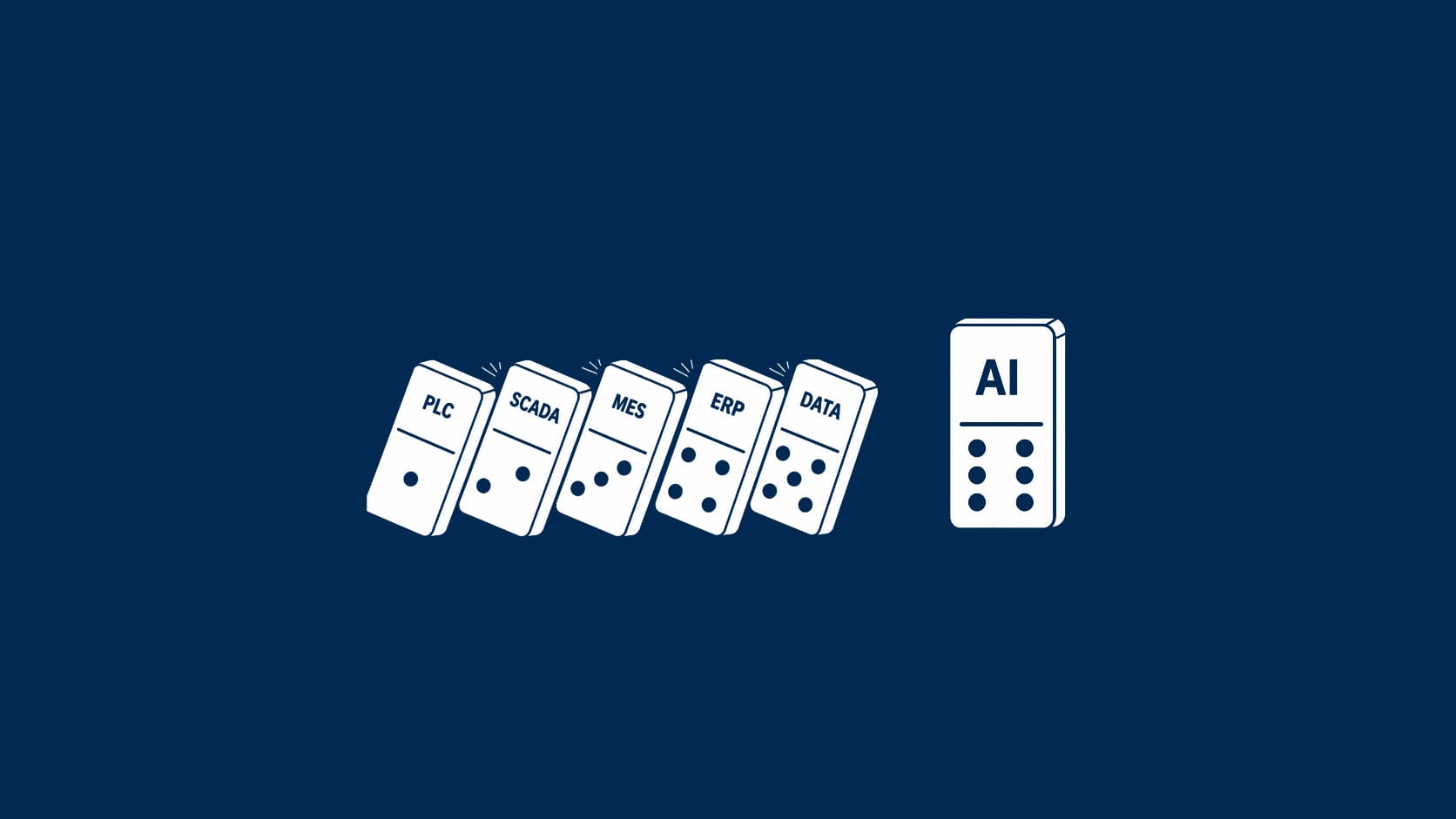
Putting the AI Cart Before the Disconnected Systems Horse: Why Integration Has to Come First
The industrial technology market is sending a pretty clear signal about where manufacturing is headed.
In July, Honeywell Technologies completed the sale of its Warehouse and Workflow Solutions business, which includes the Intelligrated and Transnorm brands. The company described the move as part of its effort to sharpen its focus as a pure-play automation company and position itself for what Honeywell calls the industrial transition “from automation to autonomy.”
That is an ambitious destination.
For many manufacturers, though, the more important question is what has to happen first. Meaning, a factory cannot make increasingly intelligent decisions if its production systems cannot reliably exchange information. It cannot scale artificial intelligence across operations if equipment data means something different from one line to the next. Simply put, it cannot become autonomous simply by adding another software platform on top of an already fragmented architecture.
Before autonomy can be a realistic outcome, connectivity must be in place.
The Gap Between an Automated Factory and a Connected Factory
Manufacturing has been automating processes for decades.
PLCs control equipment. SCADA systems provide visibility. MES platforms manage production. Historians collect operational data. ERP systems manage orders, inventory, materials, and business processes.
Individually, these systems may work exactly as intended. But what happens between them?
A production line can be highly automated while operators still enter information into spreadsheets. A plant can collect millions of data points while engineers spend hours cleaning and contextualizing them before they are useful. An MES can track production while the ERP receives incomplete or delayed information about what actually happened on the floor.
This is one of the less glamorous realities of digital transformation is the fact that having sophisticated technology is not the same thing as having a digitally connected operation.
The difference usually lives in the architecture between the systems.
Autonomy Requires Context, Not Just Data
Honeywell’s focus on the transition from automation to autonomy is particularly interesting because autonomous systems require much more than access to large amounts of data. They need context.
Let’s consider a single production event.
A machine stops at 10:42 a.m.
The PLC knows the equipment stopped. The SCADA system may record the alarm. The historian captures tag values. The MES knows which product and production order were running. The maintenance system may have information about previous failures. The ERP understands the schedule, materials, and customer commitments.
Each system holds a piece of the story.
The real value appears when those pieces can be connected.
A truly connected operation can begin answering useful questions about this event, rather than just logging it. For instance:
What was being produced?
Which operating conditions changed before the stop?
Has this failure happened before?
Did it affect product quality?
How much production was lost?
Does the schedule need to change?
Is maintenance intervention required?
Could the same pattern predict the next failure?
That progression is important because it illustrates where digital transformation actually happens.
It is not only inside the PLC, MES, ERP, historian, cloud platform, or analytics tool.
It happens between them.
Manufacturers Are Still Building the Foundation
The industry’s interest in artificial intelligence and increasingly autonomous operations is real, but current manufacturing investment shows how much foundational work still needs to happen.
Deloitte’s 2025 Smart Manufacturing and Operations Survey found that 92% of surveyed manufacturers believe smart manufacturing will be a primary driver of competitiveness over the next three years.
That’s an impressive statistic that undoubtedly points to the future of manufacturing, but some of the most revealing findings were further down the technology stack.
Manufacturers reported significant investment in factory automation, sensors, analytics, cloud computing, and industrial IoT. At the same time, only 54% reported using a unified data model, and 45% reported using an architecture standard.
Furthermore, AI adoption was further behind. Deloitte found that 29% of respondents were using AI or machine learning at the facility or network level.
Collectively, these numbers indicate that manufacturers are interested in what comes next, but many are still creating the technical foundation required to get there.
The Road to AI Runs Through the Plant Floor
This is also why manufacturing AI initiatives can become frustrating surprisingly quickly.
The AI model may not be the problem.
The underlying environment may simply not be ready to support it.
AI is much more useful when production data is consistently collected, contextualized, accessible, and connected to the systems that explain what the data actually represents.
Without that foundation, even relatively straightforward questions can become difficult.
Which tags represent the same measurement across five production lines?
Are downtime reasons recorded consistently?
Can production data be associated with a specific SKU, batch, shift, or work order?
Are quality outcomes be traced back to the process conditions that produced them?
Does data move reliably between OT systems and enterprise applications?
If answering those questions requires manually assembling information from several systems, an AI project is likely to inherit the same problem.
This is one reason we developed DASH Engineering’s Manufacturing AI Readiness Assessment.
The assessment looks beyond whether a manufacturer is interested in AI and evaluates some of the conditions that determine whether AI can actually create value, including data accessibility, system connectivity, operational processes, standardization, and governance.
Because AI readiness is not really a question of whether a factory owns enough technology. Instead, it’s a question of whether that technology can work together.
Integration Is Becoming More Strategic
Systems integration has traditionally been treated as the technical work required to make one system communicate with another.
That definition is becoming too narrow.
As manufacturers adopt more software, instrumentation, automation, analytics, cloud infrastructure, and AI, the integration layer increasingly determines what the entire technology environment can do.
Connecting a PLC to SCADA solves one problem.
Creating an architecture in which production information can move reliably from equipment to SCADA, MES, data infrastructure, ERP, analytics, and eventually intelligent applications solves a much larger one.
This is where several areas of digital transformation begin to converge:
Automation and controls create reliable machine-level execution.
SCADA and MES provide visibility and production context.
Industrial data infrastructure collects, standardizes, and makes operational information usable.
Enterprise application integration connects manufacturing activity to the systems running the broader business.
Analytics and business intelligence turn that information into visibility and decisions.
AI and advanced automation can then build on a foundation that already understands the operation.
The order matters. This is because skipping directly to the last layer rarely eliminates problems in the layers beneath it.
Start With the Connections That Matter
None of this means manufacturers need to rebuild their entire technology stack before pursuing digital transformation. In most facilities, that would be unnecessary and unrealistic.
A better starting point is identifying where disconnected systems are creating operational friction today. Taking note of where information is being entered twice, where engineers are manually combining data and where production loses visibility between systems reveals where integration can create immediate value while also building a stronger foundation for what comes next.
The future Honeywell is describing is likely coming.
Industrial systems will become more intelligent. AI will play a larger role in operations. Automation will increasingly adapt to real-time conditions rather than simply executing predetermined logic.
But autonomy will not arrive because manufacturers accumulated enough technology.
It will arrive because the systems underneath it finally learned how to work together.
The road to autonomous manufacturing does not begin with AI. It begins with architecture.


